
Dr Michael Oon’s TEDx Talk on
Science and Traditional Feng ShuiResidential Feng Shui Consultation: A Guide for Homeowners to Improve Your Life
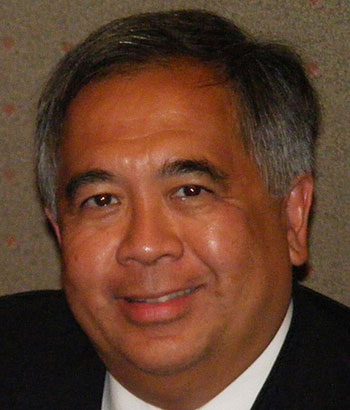
Dr. Michael Oon

Introduction
A Residential Feng Shui Consultation is a professional assessment of how a home's location, external surroundings, orientation and internal layout relate to the people living in it. Using the methodology of Traditional Feng Shui, the assessment considers how Qi (energy) is received from the surrounding environment, enters the property and is distributed within it. The aim is to identify features that may benefit from attention and provide recommendations suited to the individual home and its occupants.
A home is where people live, work, rest and spend time with family. A Residential Feng Shui Consultation considers the property's individual characteristics and the needs of its occupants. This article explains who may benefit, when to arrange a consultation and what distinguishes my approach.
In brief: A Residential Feng Shui Consultation looks at the external environment, property orientation, internal layout, distribution of Qi, timing and the needs of the occupants. Consultations are available in person in parts of southern England and online for clients elsewhere.
1. Who Benefits from a Residential Feng Shui Consultation?
A consultation may benefit anyone living in an apartment, terraced house, semi-detached house or detached home. Homes increasingly serve as workplaces as well as places for relaxation, family activities and leisure. As more people work from home, the surroundings, orientation and internal arrangement deserve consideration. Traditional Feng Shui offers a way to examine the relationship between a property, its environment and its occupants, and to consider whether appropriate recommendations may enhance the living environment.
2. Why Have a Residential Feng Shui Consultation?
One of the traditional aspirations of Feng Shui is to enhance three important aspects of life: Wealth, Health and Relationships. A residential consultation examines the property's configuration, orientation and internal arrangement to identify features that may be more or less favourable for its occupants.
People seek advice proactively or because they have particular concerns about their living environment.
Examples include:
- Financial difficulties: The property's configuration and relevant Feng Shui sectors may be examined in relation to traditional ideas of wealth and prosperity.
- Poor sleep: The bedroom's location, bed position and overall arrangement may be considered.
- Family disagreements: The internal layout and relationship between different areas of the home may be assessed.
- Lack of concentration: The location and arrangement of a study or home workspace may be reviewed.
- General dissatisfaction: A consultation can examine the relationship between the property, its surroundings and the needs of its occupants.
- Difficulty relaxing: The use and arrangement of bedrooms and living spaces may be considered.
- Changing family circumstances: A new baby, children growing up, elderly relatives moving in or changes to working arrangements may affect whether the home still meets the household's needs.
- Recurring minor problems: Where a household experiences a succession of difficulties, a Feng Shui assessment can offer another perspective by considering the property as a whole. Such problems may, of course, have entirely practical explanations.
Does Your Home Support Your Lifestyle?
A home should support the activities and needs of its occupants, from working and studying to family life and relaxation. As lifestyles change, a consultation can consider whether the living spaces remain suitable and suggest ways to make the environment more supportive.
Feng Shui is a complementary approach. It cannot guarantee that particular problems will be resolved and is not a substitute for medical, financial or other professional advice.
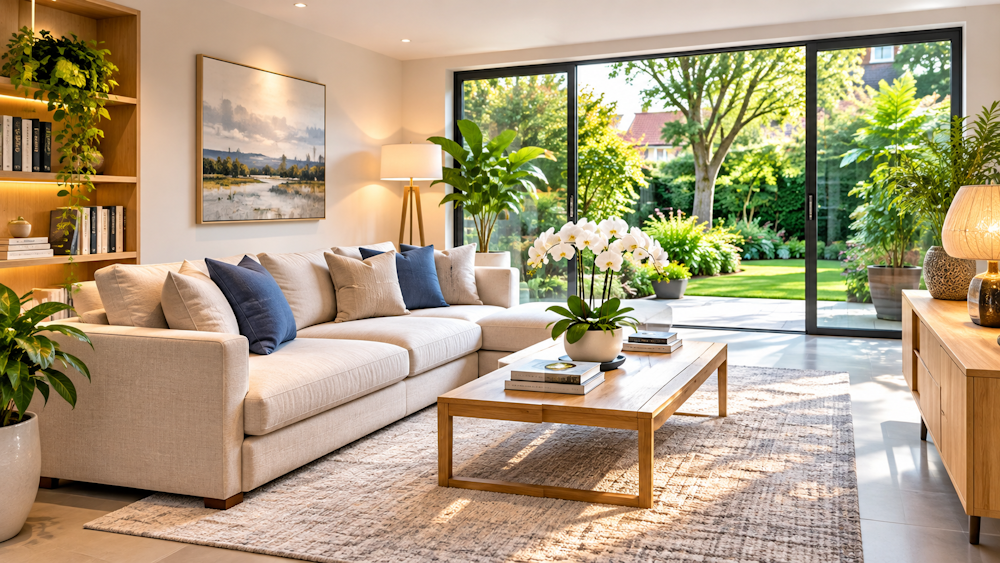
3. When Should You Have a Residential Feng Shui Consultation?
Ideally, consider a consultation soon after moving into a new home. A pre-emptive assessment allows the property's characteristics to be reviewed before occupants establish their routines. However, there are several other appropriate times to seek advice:
- After moving into a new home: The property's orientation, surroundings and internal configuration can be assessed.
- Before major renovations: Feng Shui recommendations can be considered during the planning and design stages of an extension, renovation or internal reconfiguration.
- When family circumstances change: A growing family, children becoming older, elderly relatives moving in or new working arrangements may change how the property is used.
- When dissatisfied with the living environment: A consultation offers an opportunity to consider the home from a Traditional Feng Shui perspective, even if there is no obvious practical problem.
- For a review of an existing property: You do not need to move or renovate. An assessment may identify aspects of the configuration, orientation or internal arrangement that could benefit from attention.
- When problems arise: Some people seek advice when experiencing recurring concerns involving family relationships, sleep, concentration or general household circumstances. The other type is dealing with faults that keep happening with the building.
You do not need to wait until something goes wrong before having your home's Feng Shui assessed. A pre-emptive consultation can be as worthwhile as one undertaken in response to a concern. Feng Shui cannot guarantee a particular outcome, but an assessment can help occupants understand their environment and consider possible adjustments.
4. What Methods Are Used in a Residential Feng Shui Consultation?
A consultation goes beyond furniture positions or auspicious objects. Using Traditional Feng Shui, I assess the external surroundings, internal configuration and relationship with the occupants, including how Qi is received, enters and is distributed within the property.
An Individual Approach
Every property has different characteristics, shaped by its location, orientation, architecture, layout and surroundings. I do not apply one standard set of recommendations or rely on a single formula. Established systems, including Flying Stars, are recognised methods, but their application must suit the property and its circumstances. My recommendations follow an individual assessment.
What Does the Assessment Examine?
Six principal areas are considered:
- External environment: The geographical surroundings, roads, neighbouring buildings, landscape, landform and the relationship between the property and its immediate environment.
- Property orientation: The building's orientation, sitting and facing directions, and relationship with its surroundings.
- Internal layout: The position of the main entrance, bedrooms and living areas; kitchen and bathroom arrangements; and the circulation and relationship between rooms.
- Distribution of Qi: How Qi is received from outside, enters and circulates within the property, and whether some areas appear less favourable within the Feng Shui assessment.
- Time: The influence of time and relevant Feng Shui periods on the property's assessment. Timing may also inform recommendations or the selection of dates for particular activities.
- Occupants: The number of people living in the property, their individual circumstances and requirements, and the suitability of the home for their needs.
Recommendations and Adjustments
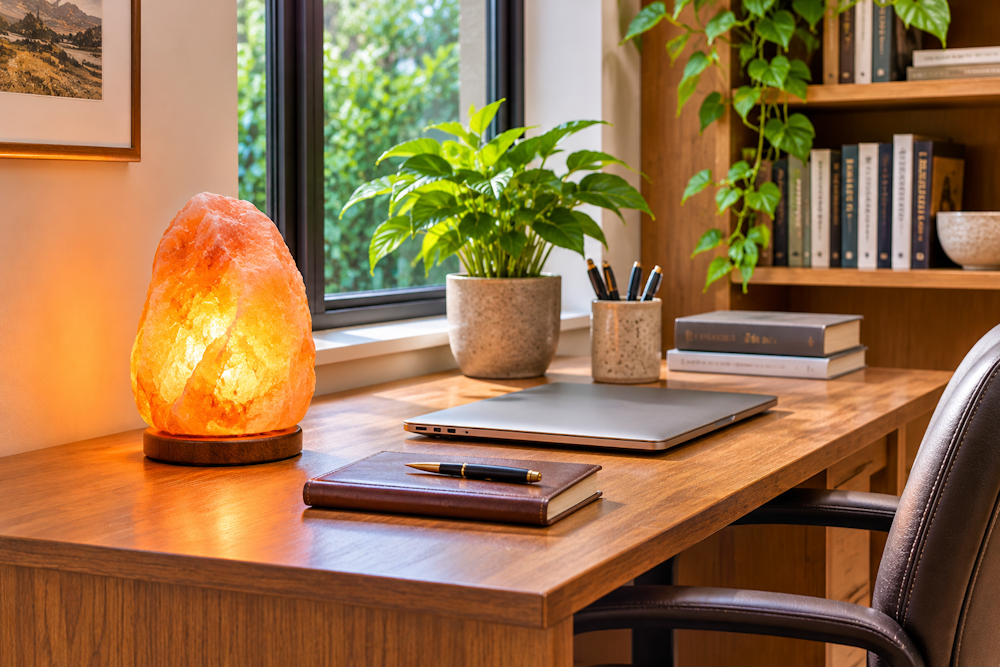
Recommendations may involve room use, furniture positioning or specific Feng Shui techniques, such as Himalayan salt lamps or other neutralising measures where appropriate. These are not universal remedies. Wherever possible, adjustments can be made within the existing property without major structural alterations or changes to its décor.
5. Residential Feng Shui Consultations Available?
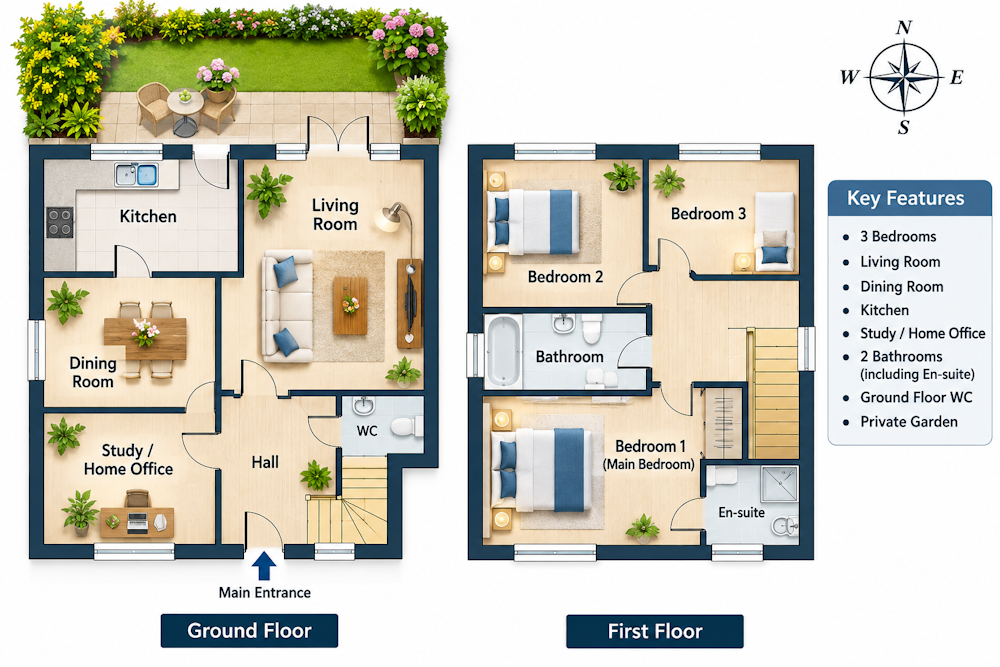
Consultations are available in person and online. Physical consultations – South of England: I offer on-site consultations in London, Surrey, Hampshire, Kent and Sussex, allowing me to examine the property's surroundings, orientation and internal configuration directly. Online consultations – Europe and worldwide: Remote assessments use floor plans, a street address for Google Earth, and other relevant information. Both formats follow Traditional Feng Shui principles and are tailored to the property and its occupants.
6. What Results Can You Expect?
A consultation assesses the relationship between a property, its surroundings and its occupants, identifying opportunities to improve the living environment. Traditional Feng Shui seeks to support the aspirations of Wealth, Health and Relationships and to minimise potential obstacles and less favourable influences.
Depending on the property and the recommendations made, a consultation may help occupants to:
- Develop a greater sense of calmness and harmony in the home.
- Identify aspects of the property that may be less favourable from a Feng Shui perspective.
- Review the suitability and use of particular living spaces.
- Consider the home environment for work, rest and family activities.
- Understand the property's characteristics and possible adjustments.
It is important to have realistic expectations. Feng Shui cannot guarantee wealth, good health, successful relationships or freedom from household problems. Nor is it a substitute for medical, financial or other professional advice. The outcome depends on the property, the recommendations and their implementation. Feng Shui is best understood as a complementary approach to considering the relationship between people and their living environment.
7. Case Studies and Client Experiences
We place great importance on client confidentiality and professional discretion. These anonymised summaries, with details generalised to protect privacy, illustrate clients' circumstances, the approach taken and their reported experiences.
Case Study 1: An Unexpected Sequence of Events
A solicitor had separated from her partner about two months earlier and felt that several matters in her life had come to a standstill.
I recommended several adjustments, including using the main entrance rather than entering through the garage. During my visit, she received an offer at the asking price for her car, with collection arranged for the following day. She then received an email from her former partner proposing a financial settlement that included their daughters' school fees. The school also offered a reduction in fees because of the family's changed circumstances.
Feng Shui interpretation: My assessment identified the use of the garage entrance, rather than the main entrance, as an aspect requiring attention. In Traditional Feng Shui, the main entrance is regarded as an important point through which Qi enters a property. I recommended using it as the principal entrance, with the intention of improving how Qi was received into the home. The timing of the three developments was striking to the client.
Case Study 2: Previous Remedies Had Not Produced the Desired Results
The woman was employed, had read widely about Feng Shui and had consulted several practitioners. Her husband's start-up business was nevertheless struggling.
I identified what I considered an issue with the availability and distribution of Qi. I recommended positioning a Himalayan salt lamp according to my procedure and activating it at specific times using Qi Men Dun Jia. After one to two months, the husband reported increased business activity and enquiries from the UK, Dubai and Singapore.
Feng Shui interpretation: In my assessment, the property was not receiving and distributing Qi favourably for the intended purpose. I used the lamp as part of a method intended to direct available Qi towards a particular area or purpose, with activation timed using Qi Men Dun Jia. The subsequent enquiries were encouraging for the couple, although they do not establish that the Feng Shui adjustment caused the business improvement.
These experiences illustrate why I assess each property individually. Every home and household has different characteristics, circumstances and aspirations; a recommendation suitable for one property may not be appropriate for another.
Case Study 3: Resolving Recurring Building Problems
A client contacted me to explain that his building was experiencing a continuous series of problems. These included glass panels becoming dislodged from the railings, a picture frame cracking and roof fittings coming loose. It seemed that as soon as one problem was repaired, another would arise.
He had consulted various contractors. Although they were able to carry out the necessary repairs, none could identify an underlying cause for the recurring problems.
I reviewed the dates of the refurbishment and discovered that construction had commenced in an area associated with the Tai Sui (Grand Duke Jupiter). The client also explained that the construction process itself had been particularly troublesome, with numerous problems and delays.
Following my assessment, I recommended placing a large container of water at a specific location within the property and introducing it at a carefully selected time.
Following this adjustment, the client reported that the recurring building problems ceased.
Understanding the Tai Sui (Grand Duke Jupiter)
In Traditional Feng Shui, annual afflictions are associated with particular compass sectors. These change from year to year and should be considered when planning construction, renovation, or other significant building work.
One of these is the Tai Sui, commonly known as the Grand Duke Jupiter. It is traditionally associated with authority and occupies a specific 15-degree compass sector each year.
According to Traditional Feng Shui principles, this sector should be treated with care. It is generally advisable to keep the area relatively undisturbed and avoid facing it directly or undertaking major construction work within it.
In this case, the client had commenced construction in the sector occupied by the Tai Sui for that particular year. My assessment took this into consideration, together with the timing and circumstances of the refurbishment.
An important consideration: When planning a construction or renovation project, it is advisable to consider not only the physical work involved but also the timing and location of the proposed activities. Traditional Feng Shui takes these annual influences into account when selecting an appropriate date and time to commence work.
8. What Makes My Residential Feng Shui Consultation Different?
My approach combines Traditional Feng Shui with additional techniques developed through my practice. Alongside space, location, orientation and the distribution of Qi, I consider how energy from the external environment may be received and used within the home.
1. Working Directly with the Energy in the Environment
I examine the relationship between external Qi, the property and its occupants: how Qi may be received and directed into the home, how it is distributed internally and how its availability and positioning may benefit the occupants. This places emphasis on the individual property rather than standard remedies or predetermined formulae.
2. Using Existing Energy
I also consider how existing energy within a property may be used more effectively, without necessarily making physical alterations. One example is positioning a Himalayan salt lamp as part of a particular Feng Shui procedure. The lamp is intended to direct available Qi towards an identified area or purpose, and its activation is timed using Qi Men Dun Jia.
Another consideration is Geopathic Stress, sometimes called Geopathic Stress Radiation. This is a concept used by some practitioners to describe purported environmental influences associated with the ground beneath or around a property. Claims that it causes poor sleep, tiredness or illness have not been established by reliable scientific evidence. Where relevant, the concept may be considered as part of the overall assessment, but it should not be treated as a medical diagnosis.
These methods form part of my broader aim of considering how the existing environment may contribute to a calmer and more harmonious home.
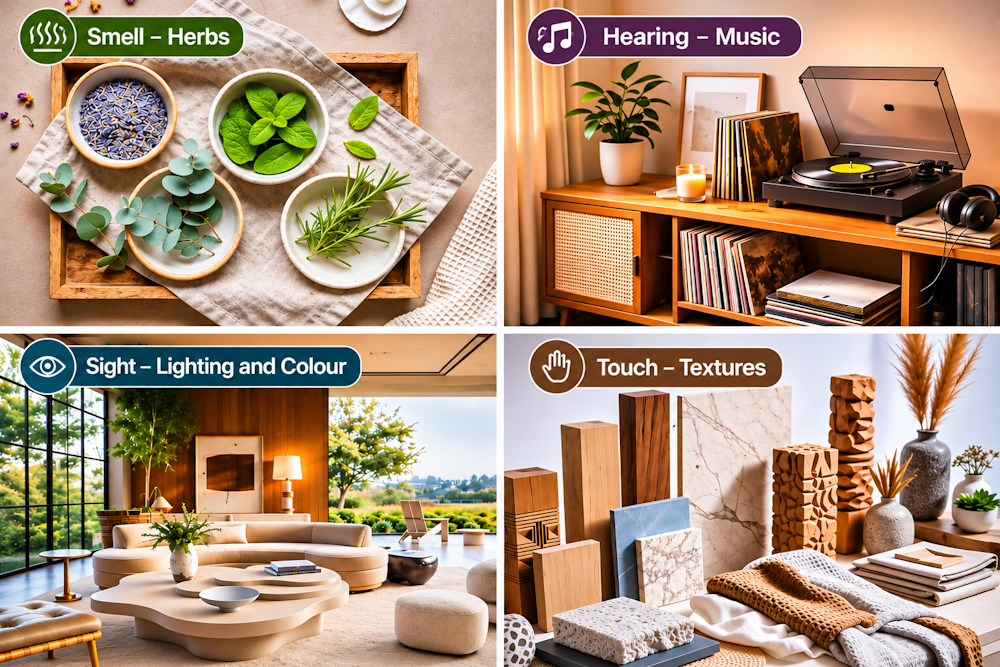
3. Using the Human Senses
A home's atmosphere is also experienced through smell, hearing, sight and touch. I consider how these senses may complement the Feng Shui assessment:
- Smell: Selected herbal scents may be used to create a particular atmosphere. My approach considers herbs rather than essential oils or conventional aromatherapy products.
- Hearing: Appropriate music may help create a relaxing atmosphere, support concentration or provide a pleasant background for everyday activities.
- Sight: Natural and artificial lighting, the intensity and positioning of lights, and the colours used in different areas all contribute to how a room is experienced.
- Touch: Textures, fabrics and natural materials influence how comfortable and welcoming a space feels. Their selection can complement the intended atmosphere of a room.
These sensory considerations may offer relatively simple ways to adjust the experience of a home without major renovation or substantial changes to its décor. The effect is relatively fast.
Bringing the Elements Together
These additional techniques complement the established Feng Shui considerations of space, location, orientation and the movement of Qi. My aim is to look beyond the positioning of furniture and objects by examining the external environment, the property and its occupants as a whole. Recommendations are developed for the individual household, rather than taken from a standard list of remedies.
A Different Approach to Residential Feng Shui
My approach goes beyond the conventional assessment of space, location and energy flow. I examine how Qi from the external environment may be received and distributed within the home, while considering the individual needs of its occupants and the sensory qualities of their living environment. Each consultation is tailored to the property and the people who live there.
Frequently Asked Questions (FAQ) About Residential Feng Shui Consultation
What is a residential Feng Shui consultation?
It is an individual assessment of a home's surroundings, orientation, internal layout and relationship with its occupants, using the principles of Traditional Feng Shui. The aim is to understand the property's Feng Shui characteristics and identify appropriate recommendations.
Who can benefit from a residential Feng Shui consultation?
Anyone living in a house or apartment may consider a consultation. It may be relevant when moving home, planning renovations, adapting a property to changing family circumstances, reviewing an existing home or considering concerns about the living environment.
When is the best time to arrange a Feng Shui consultation?
A consultation can be useful soon after moving into a new home or before major renovation work begins. It can also be considered when household circumstances change, when occupants are dissatisfied with their environment or when they would like a professional review of an existing property.
What does a Feng Shui consultant assess?
The assessment may consider the external environment and landform, the property's orientation and sitting and facing directions, the internal layout, the way Qi is received and distributed, relevant timing considerations and the needs of the occupants.
Do I need to make structural changes to my home?
Not necessarily. Recommendations depend on the property and the findings of the assessment. They may involve the use of rooms, furniture positioning or specific Feng Shui adjustments. Where possible, recommendations can be considered without major structural alterations.
Can I have a residential Feng Shui consultation online?
Yes. Online consultations can be arranged using information such as floor plans, photographs, property orientation and other relevant details. The assessment is tailored to the property and its occupants, as with an in-person consultation.
Where are in-person consultations available?
On-site consultations are offered in parts of the South of England, including London, Surrey, Hampshire, Kent and Sussex. Online consultations are available for clients elsewhere in the UK, Europe and internationally.
Can Feng Shui help with wealth, health and relationships?
Wealth, Health and Relationships are traditional aspirations associated with Feng Shui. A consultation considers the property from this perspective and may identify areas for attention. Feng Shui cannot guarantee financial, health or relationship outcomes and should not replace medical, financial or other professional advice.
What is the difference between Traditional Feng Shui and general decorating advice?
A Traditional Feng Shui assessment considers the property's location, surroundings, orientation, layout, Qi and timing, as well as the occupants' needs. It is not simply a set of decorating rules or a recommendation to place particular objects in every home.
What information is useful for an online consultation?
Useful information may include a floor plan, photographs of the property and its surroundings, the property's orientation and relevant details about the occupants and their requirements. The information needed will depend on the individual property and consultation.